A Fluid Flow Data Set for Machine Learning and its Application to Neural Flow Map Interpolation
Jakob Jakob, Markus Gross, Tobias Günther
External link (DOI)
View presentation:2020-10-29T18:15:00ZGMT-0600Change your timezone on the schedule page
2020-10-29T18:15:00Z
Fast forward
Direct link to video on YouTube: https://youtu.be/6gKr7YmA0QE
Keywords
Scientific visualization, deep learning, flow maps
Abstract
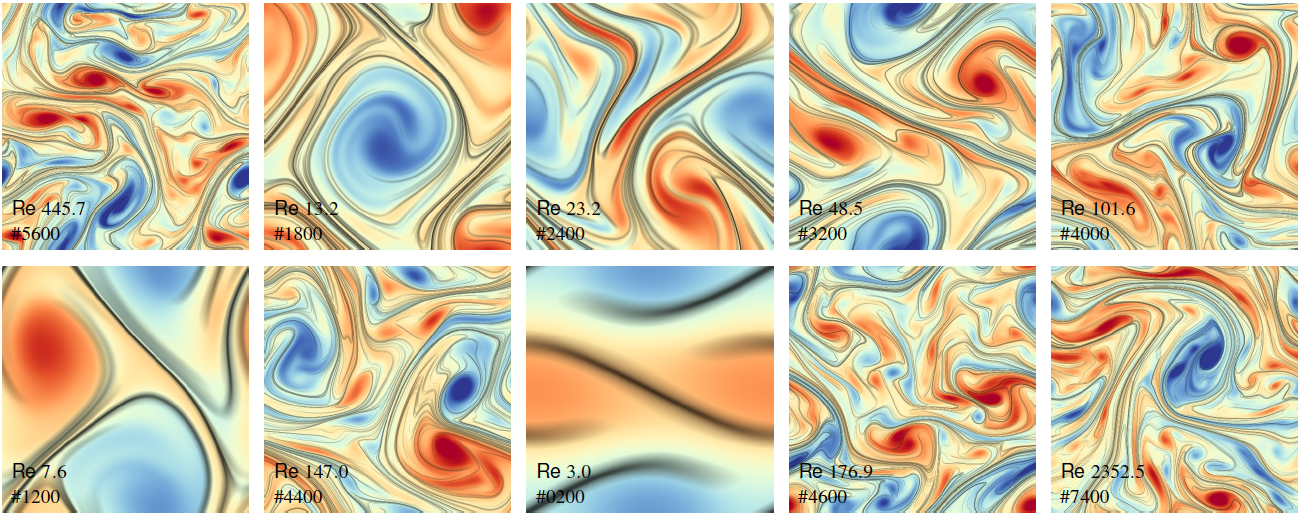
In recent years, deep learning has opened countless research opportunities across many different disciplines. At present, visualization is mainly applied to explore and explain neural networks. Its counterpart - the application of deep learning to visualization problems - requires us to share data more openly in order to enable more scientists to engage in data-driven research. In this paper, we construct a large fluid flow data set and apply it to a deep learning problem in scientific visualization. Parameterized by the Reynolds number, the data set contains a wide spectrum of laminar and turbulent fluid flow regimes. The full data set was simulated on a high-performance compute cluster and contains 8000 time-dependent 2D vector fields, accumulating to more than 16 TB in size. Using our public fluid data set, we trained deep convolutional neural networks in order to set a benchmark for an improved post-hoc Lagrangian fluid flow analysis. In in-situ settings, flow maps are exported and interpolated in order to assess the transport characteristics of time-dependent fluids. Using deep learning, we improve the accuracy of flow map interpolations, allowing a more precise flow analysis at a reduced memory IO footprint.